How to build an annual plan for your swim group
A good annual plan makes it easier to peak when it matters — and it makes everyday life easier for both coach and athletes. Here is a practical approach in seven steps.
 Kim Torry Simmenes · 18 October 2026 · 6 min read
Why make an annual plan?
Many coaches keep the plan in their head, or in a spreadsheet only they ever open. That often works fine day to day, but a written annual plan gives you more:
- Direction. You know what each period is meant to achieve, and why.
- The right load. Hard and easy work is distributed on purpose, not by chance.
- A shared language. Assistant coaches, athletes and parents understand what happens and when.
- Something to evaluate against. After the season you can see what worked — and do better next year.
Step 1: Start with the competition calendar
Everything else in the plan builds on when your athletes need to perform. Enter the competition schedule first, then decide which meets matter most:
- Main competitions (one or two per season) — where the athletes should peak.
- Intermediate goals — important meets that don't require a full taper.
- Training meets — where athletes race in the middle of a training block.
Also mark holidays, training camps and periods when the pool is closed. They affect the plan just as much as the meets do.
Step 2: Divide the season into macro cycles
Macro cycles are the big blocks of the season. A common split looks like this — the numbers are guidelines and depend on level, age and how many peaks you have:
| Period | Typical length | Main focus |
|---|---|---|
| General preparation | 8–12 weeks | Technique, aerobic base, all-round development and strength |
| Specific preparation | 6–10 weeks | Event-specific speed, threshold and more quality |
| Competition period | 4–8 weeks | Race pace, starts and turns, taper |
| Transition | 2–4 weeks | Rest, play and cross-training |
Many clubs have two peaks a year — for example short course in the autumn and long course in the summer. Then you typically repeat preparation and competition twice, with a shorter transition in between.
Step 3: Break it down into meso cycles
A meso cycle is a block of 3–6 weeks with one clear theme, such as "aerobic base", "volume", "threshold" or "peak form". A clear theme makes the sessions easier to design — and easier for athletes to understand what they are working on.
Step 4: Plan the rhythm of the weeks
Micro cycles are the weeks. A widely used pattern is two or three weeks of increasing load followed by an easier week where the body can recover. Within the week, alternate hard and easy sessions, and put the toughest sessions where the athletes are most rested.
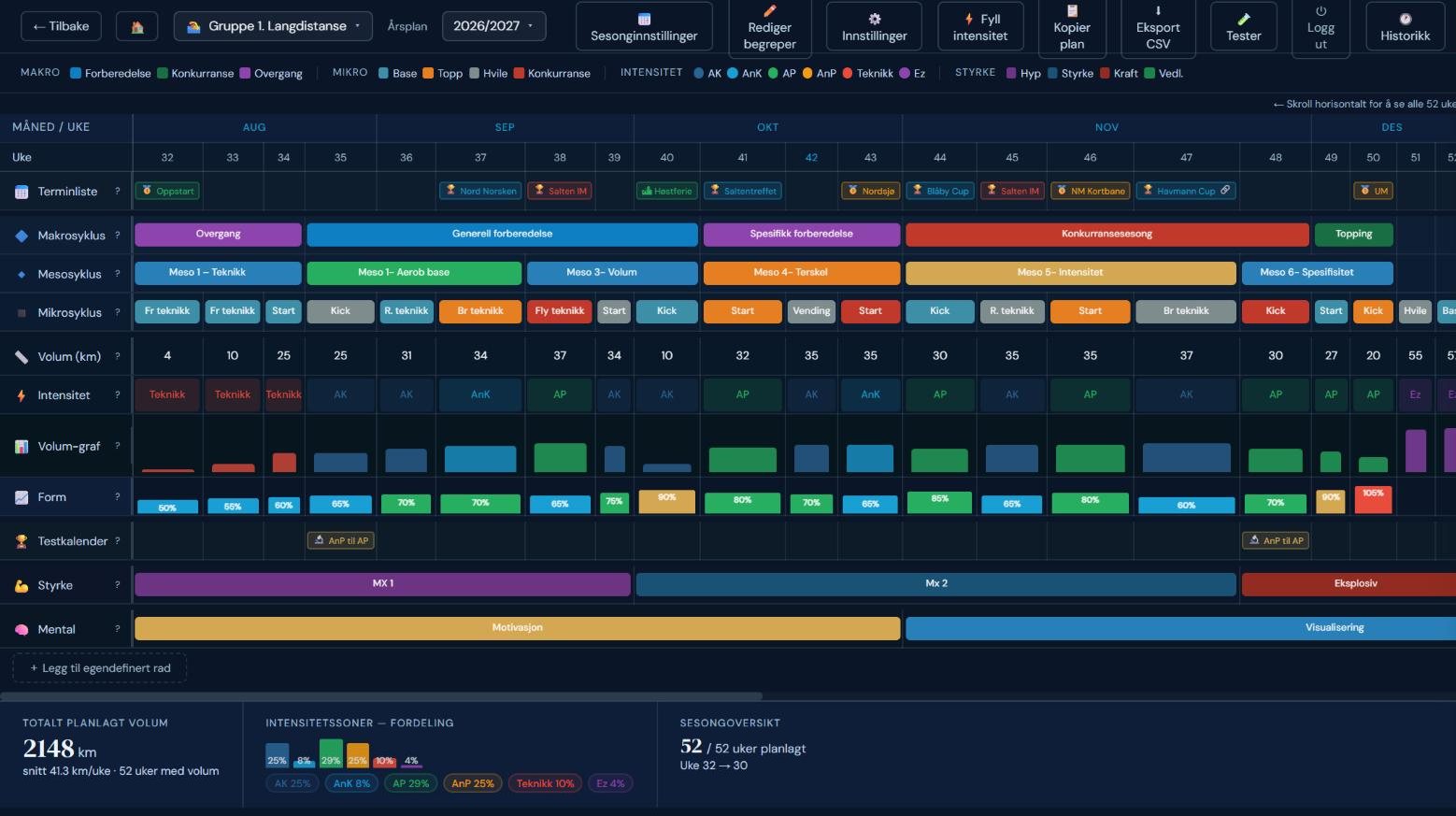
Step 5: Set volume and intensity week by week
Once the structure is in place, fill in the planned volume and main intensity for each week. Look for three things:
- Gradual increase. Avoid big jumps in volume from one week to the next.
- Easy weeks. The easier weeks from step 4 should stand out clearly in the volume curve.
- Taper. Before the main competitions, volume goes down while quality and speed are maintained.
Use the same intensity zones throughout the season, so that "zone 3" means the same in October as in March.
Step 6: Add testing, strength and mental training
Test weeks let you see whether the plan is working. Place them at the same point each season so results can be compared year on year. Plan strength training and mental training in their own periods too — that way they connect with the swim training instead of happening "whenever there's time".
Step 7: Share the plan — and adjust along the way
An annual plan is a tool, not a contract. Share it with assistant coaches and athletes, and do a short review after each meso cycle: Did volume match the plan? How did the athletes respond? Does the next block need adjusting?
Common mistakes
- Too many important meets. If everything is important, there is never time to build form.
- No easy weeks. Load without recovery rarely brings progress — and increases the risk of injury.
- The plan ends up in a drawer. A plan nobody sees doesn't steer the training either.
- The same plan for everyone. Younger athletes need more technique, play and variety, and less detailed periodisation.
Build your annual plan in AquaPlan
In AquaPlan Swimming you build the annual plan visually, break it down into weekly plans and training sets — and athletes see the plan on their phone. Free for 30 days, no card details.
See how it works →